
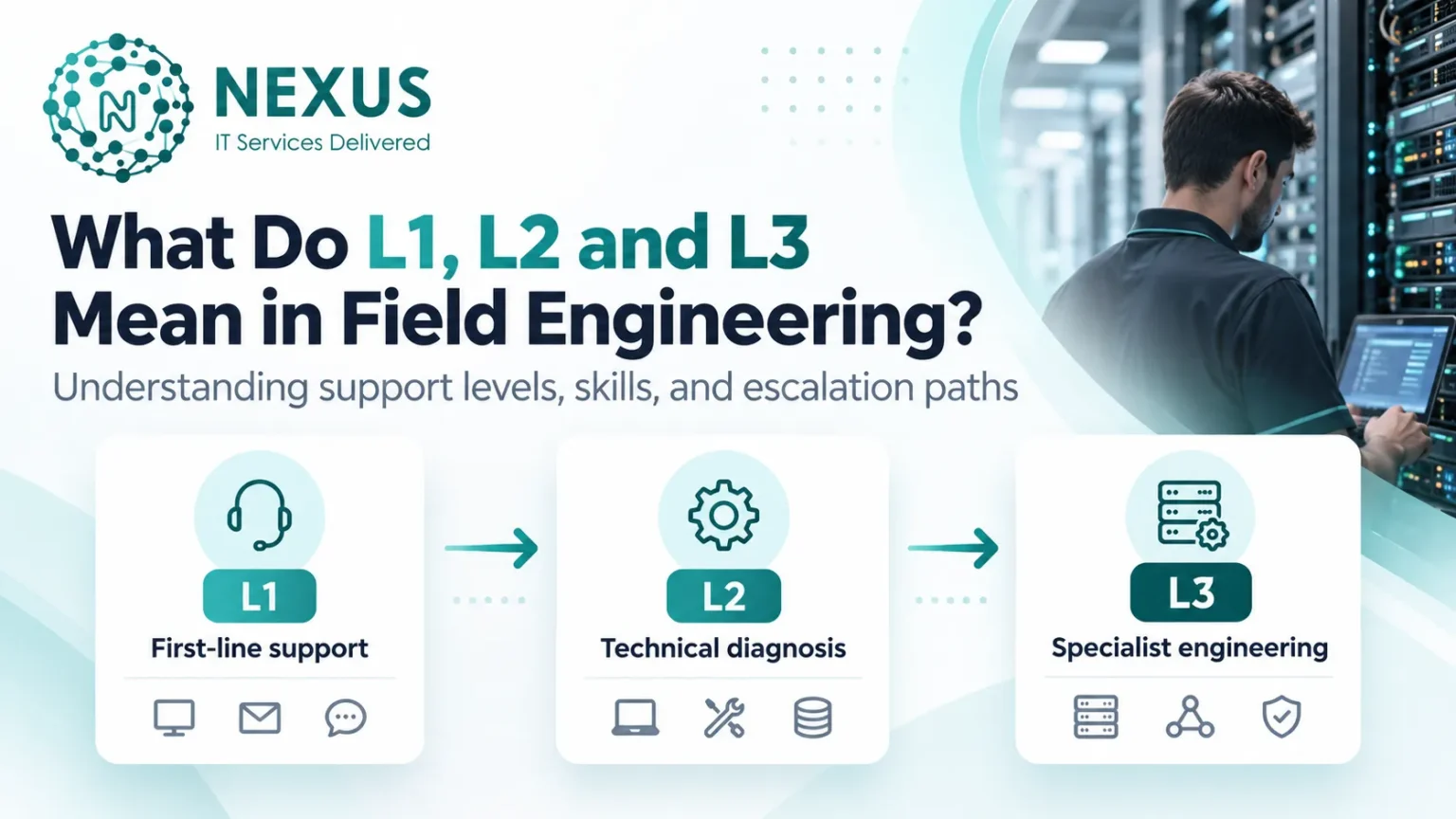
L1, L2 and L3 field engineering levels define how IT support, onsite technical support and infrastructure troubleshooting are divided by technical complexity, system access, diagnostic depth, change authority and escalation responsibility. In a typical support model, L1 field engineers handle first-line checks, physical connectivity issues, basic hardware faults, device verification and runbook-based fixes. L2 field engineers take over more complex incidents involving network switches, VLANs, DNS, DHCP, servers, operating systems, logs and configuration faults. L3 field engineers handle root cause analysis, advanced infrastructure problems, complex network or server issues, architecture-level faults and specialist engineering changes.
The escalation hierarchy usually follows L1 → L2 → L3, with each level receiving incidents that exceed the technical scope or authority of the previous tier. However, these levels describe the type of work, troubleshooting depth and technical responsibility, not simply job seniority. An experienced engineer may still perform an L1 task when the issue only requires first-line intervention.
For organisations using managed IT and field support models, including Nexus GMS, clearly defining L1, L2 and L3 boundaries helps separate basic troubleshooting, advanced diagnosis and specialist engineering while improving incident handover and reducing unnecessary escalation.
What Does an L1 Field Engineer Do?
An L1 field engineer provides first-line onsite IT support for common hardware, workstation and connectivity issues. The role focuses on basic fault identification, physical checks, approved fixes and accurate incident documentation before escalation to L2 support.
Typical L1 Tasks
Typical L1 field support includes:
- checking power, Ethernet cables, patch leads and physical connections
- resolving basic desktop, laptop and peripheral issues
- reseating or replacing approved RAM, drives, power supplies or network components
- checking LAN, Wi-Fi and device connectivity
- recording asset tags, serial numbers, IP details, error messages and device status
- following SOPs, runbooks, knowledge-base articles and troubleshooting checklists
- updating the service desk ticket with actions taken and test results
These tasks are usually low-risk and repeatable, with clear procedures and limited change authority.
L1 Skill Boundary
The L1 boundary is reached when the issue moves beyond known fixes and basic physical troubleshooting. Escalation to an L2 field engineer is appropriate when:
- standard troubleshooting does not restore service
- administrator, server or network-device access is required
- VLAN, DNS, DHCP, firewall, switch or operating-system configuration must be changed
- logs or deeper diagnostics are needed
- the fault affects multiple users, devices or services
- the incident carries higher operational risk
In simple terms, L1 verifies and applies known fixes; L2 begins deeper technical diagnosis. For managed IT environments such as Nexus GMS, this boundary helps keep first-line field support efficient while ensuring complex incidents reach the correct technical resource.
What Does an L2 Field Engineer Do?
An L2 field engineer handles technical incidents that require deeper diagnosis than first-line support. The role focuses on fault isolation, configuration analysis, system troubleshooting and controlled technical changes across networks, servers, operating systems and infrastructure components.
Typical L2 Tasks
Typical L2 field support includes:
- troubleshooting network switches, switch ports and VLANs
- diagnosing DNS, DHCP and IP addressing issues
- performing server and service diagnostics
- resolving Windows or Linux operating system faults
- analysing system logs, event logs and monitoring alerts
- reviewing network, server and device configurations
- diagnosing advanced hardware, storage or component failures
- validating fixes before returning the incident to service
L2 Skill Boundary
The L2 boundary is reached when the issue requires specialist engineering, architecture-level decisions or root cause analysis beyond standard diagnostic scope. Escalation to L3 support is appropriate when:
- the root cause remains unclear after advanced troubleshooting
- network, server or infrastructure architecture must be changed
- specialist vendor, OEM or platform expertise is required
- the incident affects multiple systems or services
- the fix involves high-risk or non-standard changes
In simple terms, L2 diagnoses and isolates complex faults, while L3 handles specialist, systemic and engineering-level problems. This distinction helps organisations such as Nexus GMS route incidents to the correct technical level without unnecessary escalation.
What Does an L3 Field Engineer Do?
An L3 field engineer handles the most complex technical incidents within the internal support hierarchy. The role focuses on root cause analysis, advanced infrastructure troubleshooting, specialist configuration, architecture-level issues and permanent remediation across networks, servers, storage, virtualization and enterprise platforms.
Typical L3 Tasks
Typical L3 field support includes:
- performing root cause analysis (RCA) for recurring or high-impact incidents
- troubleshooting complex routing, switching, firewall and network performance issues
- diagnosing advanced server, storage and virtualization faults
- resolving infrastructure design or architecture problems
- implementing approved advanced configuration and remediation changes
- investigating repeated incidents, service degradation and cross-system failures
- coordinating complex cases with OEMs, software vendors and specialist support teams
L3 Skill Boundary
The L3 boundary is reached when the issue depends on external product expertise, provider-controlled infrastructure or vendor-level engineering. Escalation may therefore move to:
- OEM support for hardware or firmware defects
- software vendors for application or platform issues
- telecom providers for carrier, circuit or WAN faults
- cloud providers for hosted infrastructure or platform-level incidents
- specialist security, network, storage or engineering teams
In simple terms, L3 owns specialist diagnosis and engineering-level resolution, while external vendors or platform providers take over when the fault sits outside internal technical control. This distinction helps organisations such as Nexus GMS maintain a clear escalation path for complex infrastructure incidents.
L1 vs L2 vs L3 Field Engineers
The main difference between L1, L2 and L3 field engineers is the depth of troubleshooting, level of system access, technical authority and type of incidents they handle. L1 focuses on triage and known fixes, L2 performs deeper diagnosis and controlled configuration work, while L3 handles root cause analysis, specialist engineering and high-complexity infrastructure issues.
| Attribute | L1 Field Engineer | L2 Field Engineer | L3 Field Engineer |
| Main role | Triage and first-line support | Technical diagnosis | Specialist engineering |
| Skill depth | Basic/foundational | Intermediate to advanced | Expert/domain-specific |
| Troubleshooting | Known fixes and runbooks | Complex fault isolation | Root cause analysis |
| System access | Limited | Controlled/privileged | Advanced/specialist |
| Change authority | Low | Moderate | High, within change controls |
| Typical scope | Hardware, cabling, endpoints, basic connectivity | Networks, servers, OS, logs, configuration | Architecture, advanced infrastructure, recurring failures |
| Escalates to | L2 support | L3 support | Vendor, OEM or specialist team |
In practical terms, L1 asks “Can this be fixed using a known procedure?”, L2 asks “Why is this issue happening?”, and L3 asks “What technical change will permanently resolve it?” This support-tier model gives organisations such as Nexus GMS a clear escalation path across field support, network infrastructure and managed IT operations.
Where the Skill Boundaries Actually Change
The boundary between L1, L2 and L3 field engineers is defined by the level of technical judgment, diagnostic depth, system access and change authority required to resolve an incident.
L1 — Procedure-Based Support
L1 support works from known fixes, SOPs, runbooks and troubleshooting checklists. The engineer verifies symptoms, performs basic hardware and connectivity checks, applies approved solutions and documents the outcome. If the issue cannot be resolved through a standard procedure, it moves to L2.
L2 — Diagnostic Support
L2 support goes beyond known fixes and investigates why the problem is occurring. This can involve log analysis, network testing, server diagnostics, configuration review, fault isolation and controlled changes across systems such as DNS, DHCP, VLANs, operating systems and network devices.
L3 — Engineering-Level Support
L3 support handles issues that require specialist knowledge, root cause analysis or engineering-level remediation. L3 engineers investigate recurring failures, complex infrastructure faults, advanced network or server problems, architecture issues and high-impact configuration changes.
In simple terms, L1 follows the procedure, L2 diagnoses the fault, and L3 engineers the solution. This distinction gives organisations such as Nexus GMS a clear framework for routing incidents to the correct level of technical expertise.
How Escalation Works Between L1, L2 and L3
Escalation between L1, L2 and L3 field engineers should transfer both the incident and the technical context already gathered. The process starts with incident identification, including the affected user, device, service, location, symptoms and business impact.
L1 support performs approved first-line troubleshooting and records the results. If the issue remains unresolved, the ticket should include tests performed, logs, error messages, device status, timestamps and previous actions before moving to L2.
L2 support reviews that evidence, performs deeper network, server, operating system or configuration diagnostics, and isolates the fault. Escalation to L3 is appropriate when the issue requires root cause analysis, specialist engineering, architecture changes or vendor-level expertise.
A complete handover should state:
- what failed
- what has already been tested
- what evidence was collected
- why escalation is required
- what technical scope remains unresolved
This creates a clear L1 → L2 → L3 escalation path, reduces duplicate troubleshooting and helps organisations such as Nexus GMS move incidents efficiently between support tiers.
Skill Boundaries by Technology
The practical difference between L1, L2 and L3 field engineers becomes clearer when responsibilities are mapped to specific technologies. As incident complexity increases, the work shifts from basic verification, to technical diagnosis, to specialist engineering and architecture-level resolution.
| Technology | L1 Field Engineer | L2 Field Engineer | L3 Field Engineer |
| Workstations | Basic device, power and peripheral checks | OS, driver and software diagnosis | Platform, image or enterprise endpoint issues |
| Network | Cable, port and link-status checks | VLAN, switch-port, DHCP and DNS diagnosis | Routing, firewall, topology and network design issues |
| Server | Power, cabling and hardware verification | OS, service, storage and log diagnosis | Architecture, virtualization and platform-level faults |
| Wi-Fi | Basic connectivity and access-point checks | AP configuration, channel and authentication diagnosis | Controller, RF design and wireless architecture issues |
| Hardware | Reseat or replace approved components | Diagnose component or device failures | Complex infrastructure, compatibility or platform faults |
In simple terms, L1 verifies the physical and known issue, L2 diagnoses the technical fault, and L3 resolves the underlying infrastructure or design problem. This technology-based boundary helps organisations such as Nexus GMS assign the correct engineering level to each incident.
FAQs
1. What is the difference between L1, L2 and L3 field engineers?
L1 handles basic troubleshooting, L2 performs advanced diagnosis, and L3 manages root cause analysis and specialist engineering issues.
2. What does an L1 field engineer do?
An L1 engineer handles first-line support such as cable checks, hardware checks, connectivity issues and runbook-based fixes.
3. What does an L2 field engineer do?
An L2 engineer diagnoses complex network, server, operating system and configuration issues that L1 cannot resolve.
4. What does an L3 field engineer do?
An L3 engineer handles advanced infrastructure faults, root cause analysis, architecture issues and specialist remediation.
5. When should an L1 issue be escalated to L2?
Escalation is needed when standard fixes fail, deeper diagnostics are required or configuration changes need higher-level access.
6. Is L3 the highest level of IT support?
L3 is usually the highest internal support tier, but complex issues may still be escalated to OEMs, vendors, telecom providers or cloud specialists.